Peter Eriksson reelected
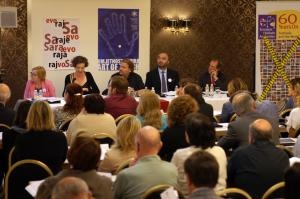
Peter Eriksson, President of Swedish Music Festivals, was reelected on the board of the European Festivals Association on 28 February 2014 during the General Assembly of EFA in Sarajevo, Bosnia and Herzegovina The GA was hosted by the International Festival Sarajevo Winter who celebrated its 30th anniversary. Some 100 festival directors representing 62 festivals in 22 countries attended the EFA gathering, 2014 marks a historic year: it is 100 years after the outbreak of World War I; the 60th anniversary of the European Cultural Convention; 30 years after the Winter Olympics in Sarajevo; and 10 years after the 2004 EU enlargement, the largest single expansion of the EU.
The new EFA Board includes
Vice Presidents Michael Herrmann (Rheingau Musik Festival, Germany) and Massimo Mercelli (Emilia Romagna Festival, Italy), and Board members Colm Croffy (Association of Irish Festival Events, Ireland), Paul Dujardin (Centre for Fine Arts Brussels – BOZAR, Belgium), Filiz Eczacibasi Sarper (International Izmir Festival, Turkey), Peter Eriksson (Swedish Music Festivals, Sweden), Ibrahim Spahic (International Festival “Sarajevo Winter”, Bosnia and Herzegovina), Hermann Schnitzer (Settimane Musicali Meranesi / Meraner Festwochen, Italy), Hanna Styrmisdottir (Reykjavik Arts Festival, Iceland), and Philippe Toussaint (France Festivals, France).
Read more about International Festival Sarajevo Winter
Sarajevo: Rising to the Occasion
In her latest blog post on the EFA blog Festival Bytes, EFA Secretary General Kathrin Deventer shares her thoughts on Sarajevo, and questions she takes with her to the EFA General Assembly. We are looking forward to meeting everybody later today!
“Rising to the occasion” is the motto of this year’s gathering EFA organises for festivals on an annual basis. The event is hosted by the Sarajevo Winter Festival and its Directore Ibrahim Spahic. In 2014, the festival celebrates its 30th anniversary; at a time when social unrest and demonstrations for justice and social rights hit the country and the city recently. We are 20 years after the siege of Sarajevo; and 100 years after one of the most disastrous wars, World War I, broke out due to an incident in this city. Yes: there are many good reasons to be in Sarajevo at this point in time.
Visiting Sarajevo means visiting the history of a city that has been reigned by many political entities, a city in a region where war has imposed borders where once no borders were.
It means being reminded of Europe 20 years ago, when ethnical groups were fighting in the Bosnian War and the city was under siege for more than three years. The Sarajevo Winter Festival was created 30 years ago, and continued its activities during the war. The Cellist of Sarajevo is but one of the many impressive images that many people in Western Europe know: this musician playing in the city, in bombarded places, in ruins he gives sound to.
I become very silent when I see pictures or film statements of this period. I remember them from TV. Shame on us! They remind me that mankind is not naturally peaceful and loving. Mankind can lose humanity when it loses its culture; life can become lifeless. What remains are the lessons to learn; and I hope we do. For societies to live peacefully together it needs constant care, communication, exchange and understanding; like friendships do, like relations between people do, because a society brings the most diverse people together to share a common space, a vision, commitment and responsibility: people who may not necessarily know each other, speak the same language, have the same possibilities… Let’s rise to this occasion and learn this lesson!
Sarajevo is an example that shows us that Europe is much more than 28 EU member states, but that Europe’s responsibility is defined in a global geo-political power division. Andrej Nikolaidis, a Sarajevo-born writer who escaped the city while it was under siege by Serbian forces in the early 1990s, said: “The citizens of Bosnia and Herzegovina are these days greater Europeans than the Europeans themselves, they are now the ones who are serious about European ideals, while the E.U. created a museum of abandoned ideals.” That reminds me also of today’s situation in Kiev. Yet, what do international communities really contribute? Do they have the solution?
Visiting Sarajevo means visiting Europe’s diversity where the oldest Jewish community, Muslims, Roman Catholics, Serbian Orthodox, and Protestants share the same cafes, shops, markets, houses. It brings Serbs, Croats, Turkish, Romans, Bosniaks together. But what is at stake today? Is there a nation? A longing for a nation? Do we need a nation along cultural borders? A state along nations? Why two names: Bosnia and Herzegovina?
Visiting Sarajevo also means looking at Europe’s challenges: political, cultural, social ones. Today in Sarajevo and all over the country, protesters take to the streets again and claim not only peace, but justice and social security. They are not just occupying streets and public squares but they are organising plena to create alternative governments. In Sarajevo, one such assembly was taking place at the youth centre, which was one of the most popular Western-style clubs in former Yugoslavia before the wars of the 1990s.
We will have the closing of our Assembly in this historical building that was bombarded during the war; and we will learn that politically there are so many different layers of power divided between the federal state, the city, the cantons, the representation of numbers dividing the people in Croat, Bosnians, and Serbs. Let’s ask the question: What is the role of the state?
I asked Lejla Alimanovic to introduce participants of the General Assembly to her Sarajevo. Lejla is a young student, an impressive young woman, and firm in her opinion about this city.
I want to learn about and listen to the Sarajevo of the future: her story, her ambition, her example of engaging in the city and its context. Artistically and intellectually, looking at composers, film makers, painters, writers, philosophers, the city seems to be an intellectual hot spot, an artistic creative playground: so much to learn from!
And again: what is at stake in the artistic community today? How are the artists working in Sarajevo? We will organise the Sarajevo Conversations during which Amila Ramović, Executive Director of the Sarajevo Chamber Music Festival, will speak about this. We also invited Prof. Dr. Senadin Musabegovic to analyse more profoundly the changes and challenges the city is facing today, taking into consideration its recent past and the challenges coming along with a multi-cultural/multi-ethnic community.
“Rising to the occasion” is for me to understand, feel and learn our lesson from our visit to Sarajevo. From the outside, this city seems so complex, so concentrated, everything happening in a rather small space and short time: history incarnated in people, as a friend of mine once wrote. There is material for conceiving a 500 years crossing the time visit from pre-Ottoman Sarajevo to today’s struggle for a multi-ethnic/cultural national identity.
Maybe now, it is time to say: peace in Sarajevo is the absence of war… No: peace is the right to enjoy justice, solidarity, and other things. Recently, in the New York Times I read the following: “‘If I am a Muslim, and he is a Serb or a Croat, if we are hungry, aren’t we brothers? We are at least brothers-in-stomach.’ Then he muttered, ‘I am not smart, but I just wanted to say this.’ From the other corner of the fully packed hall, someone replied: ‘If you’re here, you’re smart!’.”
Another quote coming to my mind is: “Don’t ask what the world needs. Ask what makes you come alive, and go do it. Because what the world needs is people who have come alive” (Howard Thurman).
The story of Sarajevo teaches us that time and space are fluid, in constant development; as is our opportunity to position us, citizens, in this space: our memory, awareness and our perspective on space and time give us a responsibility to take an active role in giving shape to our time and space. We can and should expect from our politicians; better let them know that we want a wider horizon, a long-term thinking in time and space for their decisions! The four to five-year periods between elections, the very often very local, regional, national commitments, make it a complicated and overlapping “conflict of interest”.
The future cannot be predicted, it has to be invented. So we, citizens, create our future. I believe in life, in inspiration, and in learning. Let’s learn our lesson. Let’s invite people to our festivals and to share our energies, dynamics, and let’s electrify them for peace and for love. The motto of Ibrahim’s festival is: “Peace, Art Freedom”. Yes, festivals bring these voices to the forefront and trigger their audiences to think about the place and time they live in, combining joy and reflection, laughter and crying, thinking and feeling, dreaming and living. They invite to visit themselves.
We can’t see the winds but feel them, we can see the clouds but not touch them – what is next, from where and what does “the New” come into the world? Rising to the occasion…
I am looking forward to share this time in Sarajevo with all EFA members.
Visiting you
is visiting me.
what I see is
what I want
or not
who I am
or not
where I want to go
or not.
visiting you
is looking
tasting
smelling
daring
risking
also failing;
looking again…
staying
for a while.
or longer.
going further.
is my life visiting you?
an endless travel?
endless seeing
flowing and
choosing
taking and giving
opportunities?
When I visit you.
I visit me.
Letting things happen
traveling
with a direction
sometimes without…
getting lost
discover the undiscovered
standing on my feet
and walk.
in life.
my life.
I chose this way
traveling to myself!
visiting myself.
being
myself.
To be!
Home.
For Ibrahim